A newspaper about Siren Theatre Company in the Brighton & Hove Gazette Newspaper in 1983 concerning the group receiving a loan of £2500 from Midland Bank to produce their album.
The article inaccurately says Siren formed “eight months ago”, which would have been in 1982, but Siren actually started in 1979 and produced their first play (with music) in 1980. The article referred to the Midland Bank in Dyke Road as being ‘behind Brighton’s lesbian rock band’. The bank was actually not aware that it was lending money to a lesbian band, which in 1983 was not a trendy thing to do!
Digital scan of a Brighton Leader Newspaper Article about a Siren performance of their play 'Hotel Destiny' at The Nightingale in Brighton, 1987.
This shows a photo of Jane Boston as the character ‘Chance’ in Siren’s play ‘Hotel Destiny’. The photo was taken by Anita Corbin (but the photo is not of Ms Corbin, as wrongly described). The preview was for the opening of ‘Hotel Destiny’ at the Nightingale Theatre in Brighton.
This is one of a number of posters used to promote Siren’s play ‘Mama’s Gone A’Hunting’. It is created in the form of an urgent telegram outlining the plot of the show, stating that woman intends leaving for a new planet without man.
The digitally produced poster was felt to be a ‘new’ form of photography at the time that it was on the high street, predating all the digitisation of photos that are now done on one’s own devices. Siren felt it reflected the futuristic content of the play.
This shows the programme cover of the pay Pulp. The programme shows a number of adverts, including from prominent lesbian organisations, such as Rackets, Dimples and Lesbian Line, as well as feminist companies such as Silver Moon bookshop Women’s Press. Nalgo (National and Local Government Officers Union) took out a full page advert supporting lesbian and gay rights. The programme promotes Siren’s cabaret show ‘Chic to Chic”, as well as their cassette ‘Siren in Queer Street’ and vinyl record ‘Siren Plays’. Page 4 & page 8 have the lyrics of seven sounds from Pulp, which were written by Jane Boston, and performed live by Siren. Page 5 has the Company Policy and a description of the play ‘Pulp’. It also shows some excerpts from reviews of previous plays. The play was directed and choreographed by Noelle Janaczewska. The artwork and layout of the programme was by Jenny Millington.
This image set depicts the cover, front and back, and cassette tape of Siren’s music release ‘Siren in Queerstreet’. It shows a list of the 13 tracks on the cassette, which included songs from some of the plays as well as songs composed by various members of Siren, and performed by Siren band. The tape was recorded at Newhaven Boys’ Club and at Real Time Studio Billingshurst. Cover photo by Susy Taylor.
This cassette was a mixture of home recording done by Deb Trethewey on a two track Sony reel-to-reel tape recorder, as well as some professionally recorded tracks at recording studios.
This shows two reviews, from The Stage and The Scotsman of Siren’s Play ‘Mama’s Gone A’Hunting”. The Stage review was completed at The Marlborough in Brighton and the Scotsman at University Chaplaincy Centre in Edinburgh.
The Stage reviewer queried the choice of the name Siren, saying it seems odd for a company ‘promoting the feminist cause’. Given that the origin of Siren in Greek mythology was a creature (part woman, part bird) who lured sailors to destruction by the sweetness of her song, the company felt that this was a very appropriate name for the company, which combined feminism and music to make their radical points!
This black and white photo shows Jane Boston, Jude Winter, Tash Fairbanks and Deb Trethewey checking the map before heading off somewhere for a performance.
This photo was taken in front of Siren’s ancient touring van. On one tour, Siren went from venue to venue on the back of an AA van, due to constant breakdown problems with the vehicle.
Social and peer support group, Sister Act, produced a monthly newsletter in the 1990s and early 2000s for and by lesbians in Cambridge and East Anglia, and this is a scan of one edition. It was a lifeline for a circulation list of 150-200 women of all ages, helping to create a genuine community for closeted gay women and out-and-proud dykes alike, at a time when their lives and concerns were much debated in parliament and the media. I was editor for a while, and lived from one women's disco to the next, meeting partners and friends who would remain in my life for decades. Nowadays I'm experiencing deja vu having to navigate the pros and cons of coming out all over again and finding a new community as a trans man, now living near Brighton.
Two reviews about the play ‘Curfew’ when it opened at the Oval House Theatre, London. The review at the top of the image is from 'Spare Rib', published in March 1982. It features a photo of Jane Boston as Calamity Jane. The review at the bottom of the photo is from 'The Stage', published in February 1982.
Digital reproduction of the cover of Spare Rib, and the review of Siren’s show ‘From the Divine’.
The reviewer, Liz Horsfield, writes that Lily is far more interested in Ruby [or}“is it me being a lesbian that makes me think so?” No matter how ‘out’ Siren was as a company, it perhaps wasn’t always obvious to the audience or reviewers.
The play opened at the Drill Hall in London for 2 weeks in 1985 and was sold out every night. It returned to the Drill Hall in January 1986,.
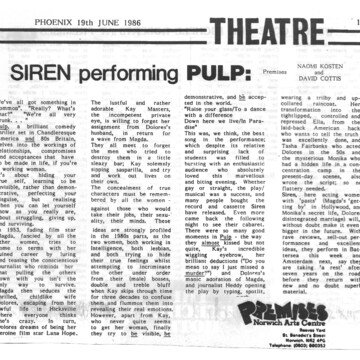
Manny describes Pulp as "a feminist play par excellence, brilliantly acted, refreshing, hilariously entertaining".
I met Stephen in a Kemp Town gym, and we became better acquainted in the jacuzzi. His partner was Omar, known to his friends as O. They became good friends of mine, and their large flat on Preston Park was always open to me and other friends. They both had a good eye for interior design and enjoyed a comfortable life. Stephen and I used to go swimming regularly at the Eastbourne leisure centre, stopping off at my house near Lewes on the way back. Somehow, I lost track of Stephen and O for a couple of years, but we reforged our friendships, stronger than ever, after we all were living with HIV. They separated at the start of the 1990’s, and Stephen died from Pneumocystis Pneumonia (PCP) in Ward 6 of Hove General Hospital in 1994.
Sussex AIDS Centre
“We held the first Brighton and Hove public meeting on AIDS in 1984 at offices in Lansdowne Place, Hove. Graham Wilkinson and I split the small cost of hiring the room and invited someone from the recently formed THT to come along and explain what they were doing in London. Both Graham and I had joined THTs small Social Work group which met at their original tiny offices in London – at that time only consisting of a couple of rooms. So, it was at this first public meeting that a handful of us volunteered to set up the Sussex AIDS Helpline.
We knew the person who at the time managed the Well-Women Clinic above a shop on the corner of Western Road and Waterloo Street in Hove. They very kindly agreed to let us use their offices in the evening when they were closed and allowed us to use a telephone line for free.
Graham and I both worked together as Social Workers in the Hanover Team based opposite St Peters Church, and we managed to get permission to use our offices in the evening for training and support groups. As professional social workers we were able to put together a training programme for the early volunteers to help handle phone calls. Graham or I would either take the calls ourselves, or be there as support for the other volunteers.
For the first 2 years Sussex AIDS Helpline got no official funding. We managed to get by with volunteer time and effort, meeting in each other’s homes, raising awareness in pubs and clubs, and by borrowing facilities and resources from the Well Women's Clinic and Social Services Hanover Team. A couple of years later we became the Sussex AIDS Centre and Helpline.”
Clive Stevens